How far should AI content automation go? — Moving high-volume tagging and translation into production
Content tagging and translation make easy generative AI demos. Enter a document and tags or translated copy appear immediately. Inspect a few plausible outputs and it is tempting to declare the work ready for automation.
Production changes the questions. Will the same rules hold across tens of thousands of items each month? Who finds a bad tag after it damages search or recommendations? Where does content go when it should not be translated automatically? Can the team compare results after a model or taxonomy changes?
Our content metadata pipeline for an entertainment and media group began with those questions. People had tagged and translated every item manually. Supporting several languages at once was difficult, and review effort rose with volume. The aim of the four-week PoC was not to collect a few impressive samples. It was to find the boundary of automatic processing with production data.
We did not target 100% automation
A system that lets AI process everything without review may report a high automation rate, but it also carries a wide operating risk. At the other extreme, checking every AI result preserves oversight without changing throughput or cost.
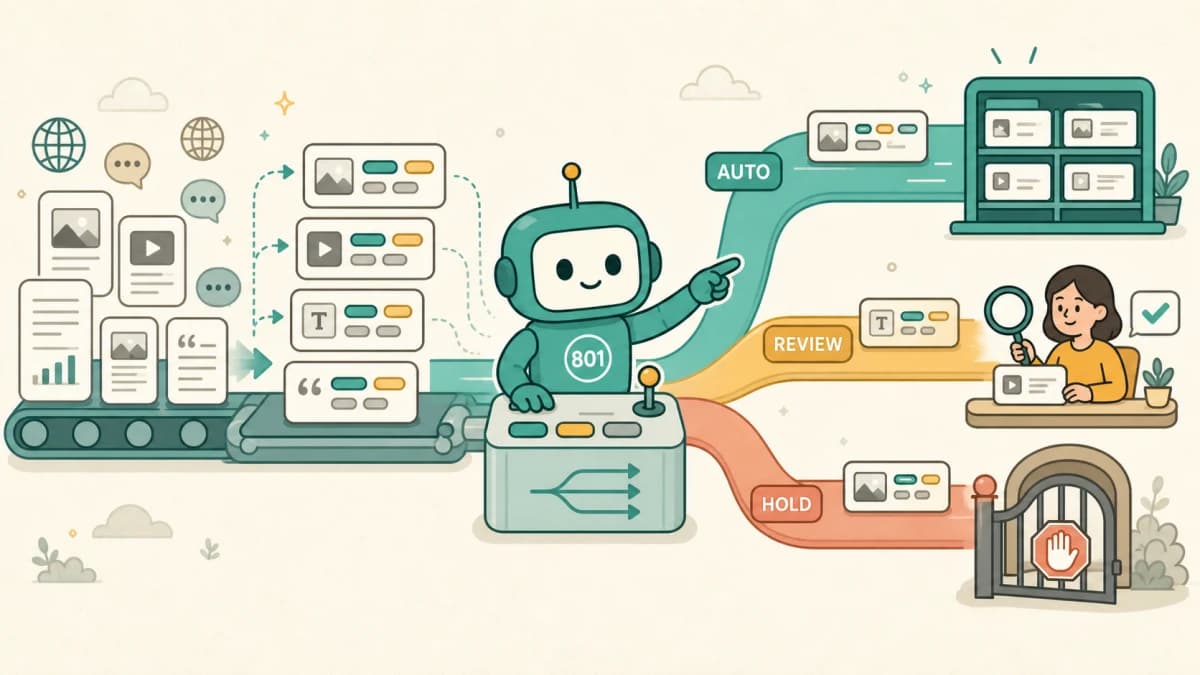
We targeted exception-based review. The pipeline handles repetitive work with explicit decision rules. A person reviews outcomes whose classification is uncertain or whose failure would materially affect the business. Human work shifts from recreating every output to deciding what sits at the boundary.
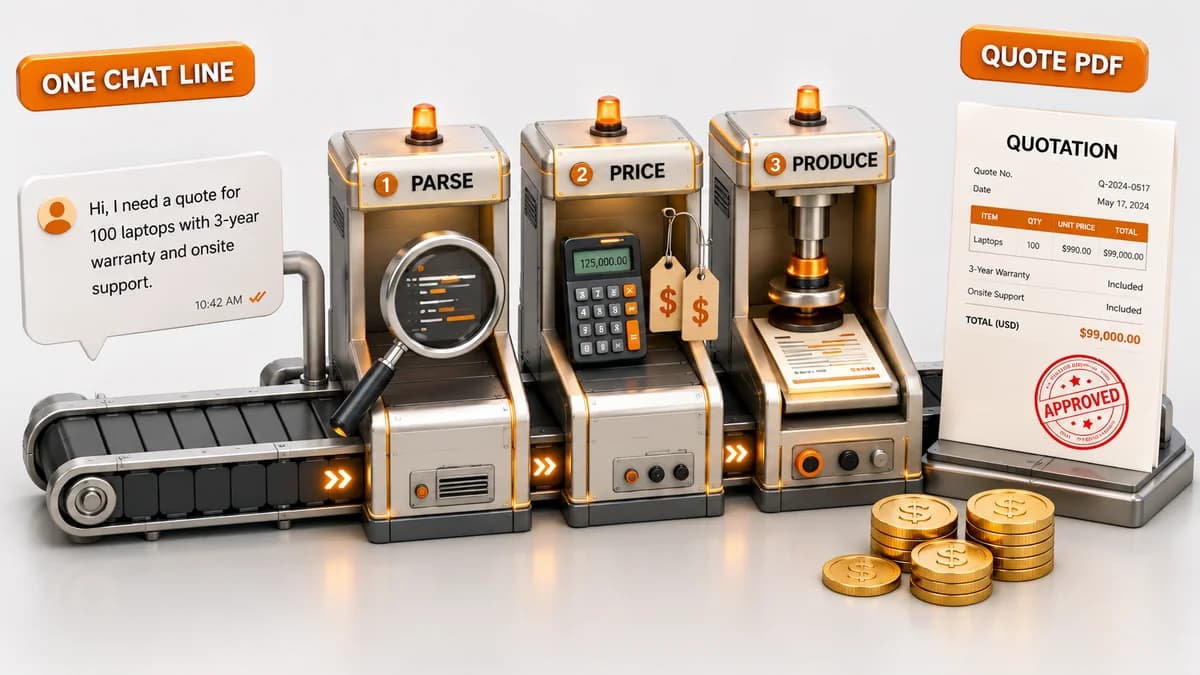
This resembles the way our quote skill keeps only price approval and sending in human hands. Define the moments that need judgment first, then automate the repeatable work between them.
We built the evaluation stack before scaling the system
An AI pipeline needs two systems: one that performs tagging and translation, and another that decides whether those results clear the operating standard. The AWS Responsible AI Lens likewise separates the AI system stack from the evaluation stack and recommends designing evaluation data, decision methods, and release criteria independently.1
"It looks good" is not an evaluation rule. Tagging needs tests for the permitted taxonomy and for whether the meaning required by search and recommendations remains intact. Translation needs checks that preserve facts and proper names while producing language people can actually publish or use. The two tasks may share a model, but their failure modes and judgments differ.
We used production data as the PoC evaluation input. Clean examples hide the long tail of the real distribution. Content with missing context, items spanning several topics, and names or expressions that should not be translated all belong in the evaluation set. These are the cases that reveal where human judgment is still required.
Amazon Bedrock evaluation supports custom datasets and automatic, model-as-a-judge, and human evaluation methods.2 The tool matters less than the contract that lets the team run the same inputs again. That contract exposes regression when a prompt or model changes.
Split processing into three routes
The operating principle from this case generalizes into three routes.
| Route | Condition | Human role |
|---|---|---|
| Automatic processing | Rules are explicit and failure has limited impact | Inspect samples and operating metrics |
| Exception review | Judgment is unstable or the business impact is material | Approve or correct the result |
| Excluded from automation | Rights, policy, or quality rules are unresolved | Agree on the rules first |
A model confidence score alone should not choose the route. Content type, how a field will be used, the downstream impact of an error, and whether a person can reverse it all matter. Even within translation, an internal search summary and externally published copy should not share the same tolerance.
The four-week PoC was time for production design
The PoC tested more than sentence quality. We defined where inputs came from, which systems received the result, how a person took over failed items, and which quality and cost measures the operation would track.
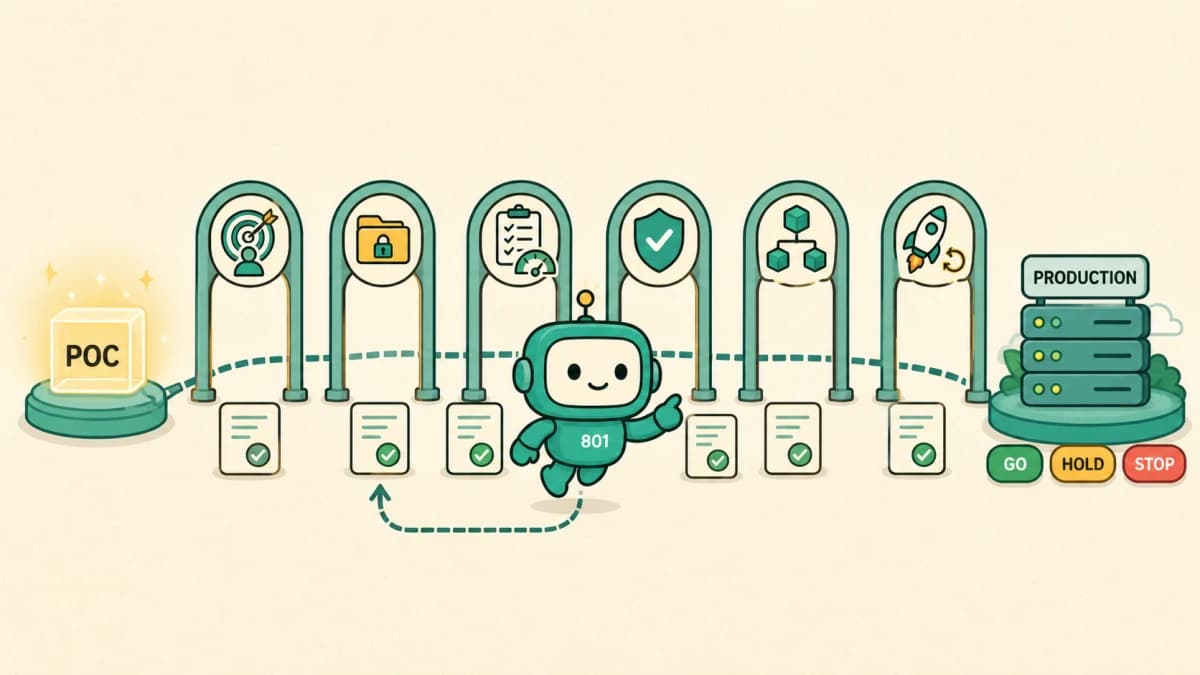
That structure is a compact version of the six gates for moving an AI PoC into production. Value and ownership, data use, real-work evaluation, failure controls, operating architecture, and rollback readiness must form one flow. A successful model call is not production readiness.
Once deployed, the pipeline processed tens of thousands of items each month across several languages. People reviewed exceptions, reducing review effort by 70%. That is not a measure of people removed. It reflects time moved from repeated full-volume checking to exception decisions. The content metadata automation Work case summarizes the problem, constraints, and production outcome.
When this conclusion does not hold
The result does not transfer unchanged to every content operation. Exception volume will remain high if the taxonomy changes often or the team cannot agree on what a correct answer means. External legal, medical, or financial disclosure content needs broader human approval because a single error can have greater impact. At low volume, when every item requires different context, the cost of operating a pipeline may exceed manual work.
Models and prompts also change. A new version can improve average quality while regressing in a particular language or content type. That is why the team should track more than automation rate: exception rate, correction types, reprocessing cost, and time to detect failure all matter. AWS also recommends documenting intended use, limitations, and known failure modes for users.3
Ask four questions before automating
Before selecting a model for content automation, ask:
- Can the business define correct and incorrect outcomes in its own terms?
- Does the evaluation set contain difficult examples from real inputs?
- Are human-review exceptions and work excluded from automation explicit?
- Can the team rerun the same criteria after a model or taxonomy change?
If any answer is missing, narrow the automation boundary. Whether AI can produce an output matters less than whether the operation can notice and reverse a bad one. The decisive work behind tens of thousands of monthly items was not model speed. It was defining that boundary.
To move content and workflow automation from PoC to production, our AX consulting work starts with scope, accountability, and evaluation criteria. Data & ML engineering carries those decisions into the evaluation pipeline and operating architecture.
References
Sources & notes3ExpandCollapse
Footnotes
-
AWS Well-Architected, Responsible AI Lens — Dataset planning. Guidance on separating AI system and evaluation stacks and designing evaluation data and criteria. ↩
-
Amazon Bedrock, Evaluate the performance of Amazon Bedrock resources. Custom datasets and automatic, model-as-a-judge, and human evaluation methods. ↩
-
AWS Well-Architected, Responsible AI Lens — Guiding. Guidance for documenting intended use, limitations, and failure modes. ↩