From AI PoC to production — how to design the transition gates
A demo earns applause when it works once. A production service must repeat the result, expose failure, and carry its cost and accountability. That is why "the model answers well" cannot be the final PoC conclusion. Data rights, exceptions, security, latency, cost, and monitoring sit outside that sentence, yet remain material parts of production.
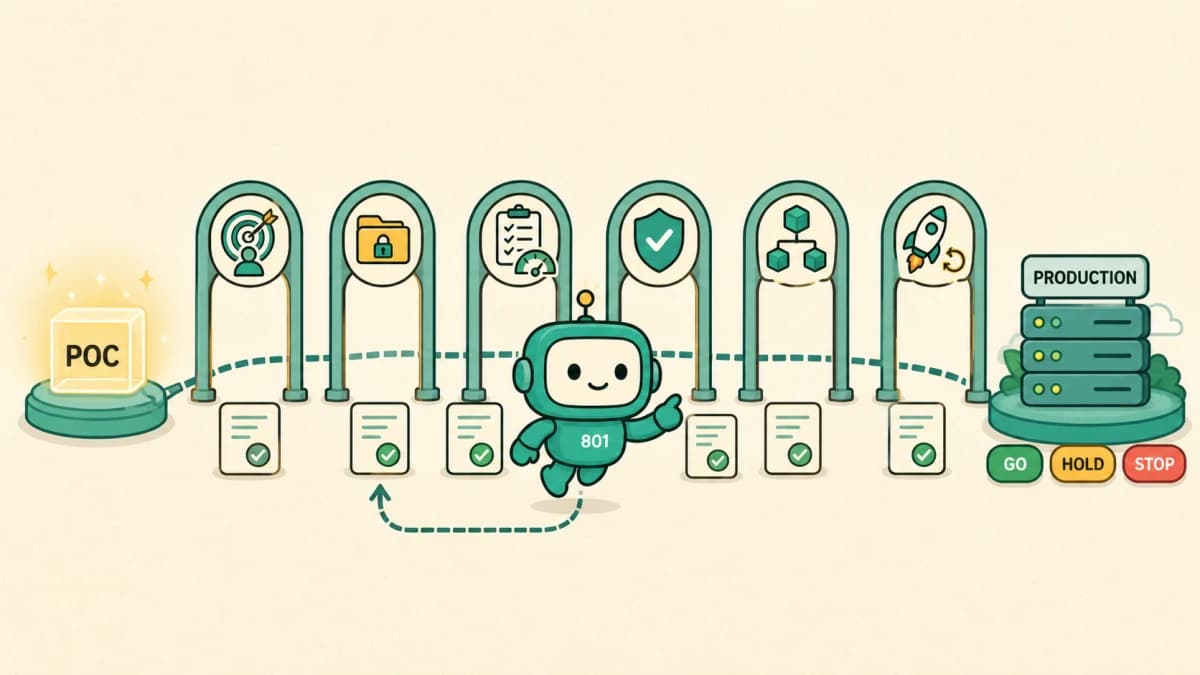
Our transition gates are not a stack of approval documents. They are decision points that name the uncertainty a team must remove before it moves forward. The NIST AI RMF treats Govern, Map, Measure, and Manage as continuous lifecycle activities, not a one-time checklist.1 The six gates below arrange that principle around a product delivery flow.
The six gates at a glance
| Gate | Question to answer | Exit evidence | Primary owner |
|---|---|---|---|
| 1. Value and scope | Whose decision or task improves? | Goals, non-goals, current baseline, business owner | Product owner |
| 2. Data and rights | May we use this data for this purpose? | Source, permission, retention, and deletion inventory | Data owner |
| 3. Quality and evaluation | Does it beat the baseline on real work? | Fixed evaluation set, versioned results, failure taxonomy | AI/product team |
| 4. Risk and control | Can we contain failure and misuse? | Threat model, human control, permission boundaries | Security/business owner |
| 5. Integration and reliability | Can we operate a changing model as a service? | SLOs, observability, cost limits, fallback path | Engineering owner |
| 6. Release and operations | Can we detect trouble and reverse course? | Limited release, rollback, runbook, review schedule | Service owner |
The gates have an order, but they are not a waterfall. A rights review can narrow the scope. A failed evaluation can reopen retrieval design. Returning to an earlier gate is useful; pushing ahead without evidence is the failure the method prevents.
Gate 1. Fix the value and the accountable owner
The first question is not "which model?" It is whose work outcome should change? Narrow the user to one group, then write one flow from starting input to final action. Name the person who takes over when the AI cannot decide.
Passing requires four things.
- A baseline for the current process in time, quality, or cost.
- A result metric to improve and guardrail metrics that must not degrade.
- A named owner accountable for the business outcome.
- Explicit non-goals and conditions that stop the PoC.
Stop here when nobody owns the outcome or success means only "people liked it." The AWS Responsible AI Lens also starts with a narrowly defined use case because that use case determines the relevant risks and release criteria.2
Gate 2. Prove data lineage and usage rights
Before model quality, establish lineage and rights. Separate user input, retrieved documents, logs, feedback, and human-labeled answers. Record the following for each.
- Data owner and source system.
- Whether the collection purpose matches the AI processing purpose.
- Personal, confidential, or copyrighted material.
- Storage region, retention, deletion, and access controls.
- Permitted use for training, evaluation, retrieval, and logging.
Exit evidence consists of a data inventory and flow, the permission basis, and a working deletion process. Narrow or stop the scope when a source cannot be explained or sensitive production data cannot be removed. The NIST Generative AI Profile treats data privacy, information integrity, supply-chain, and security concerns as distinct risks.3
Gate 3. Evaluate the work, not the demo
Evaluation does not begin with a handful of prompts inspected by eye. Build a fixed evaluation set that resembles production work and compare it with today's process. Include normal tasks, ambiguous input, unsupported questions, stale documents, unauthorized requests, and tool failures.
Do not collapse the result into one average. Track task completion, factuality and grounding, correct abstention, dangerous errors, latency, and cost per request separately. Save prompt, model, retrieval index, and evaluation-set versions together. Without that record, the team cannot distinguish improvement from regression. The NIST AI RMF Measure function likewise calls for testing before deployment, repeated measurement in operation, and documented results.1
For RAG, we split that principle into source-chunk rank, grounded generation, and follow-up context. Our RAG quality regression guide shows the test-set and release-gate design.
Pass only when every critical segment clears thresholds set before the run. A healthy average cannot excuse failure in a high-impact workflow. If the same version cannot be reproduced, it is not ready for the next gate.
Gate 4. Contain failure and misuse
Generative AI risk extends beyond a wrong sentence. Consider prompt injection, data exfiltration, excessive tool permissions, and the compound effect of automated actions at the system boundary.
Classify failures by impact, then attach a control to each class. User confirmation may cover low-impact outcomes; high-impact actions need human approval or no automated execution. Treat retrieved content and user input as separate trust boundaries. Give every tool the minimum data and actions it needs. Keep sensitive values out of logs while preserving identifiers needed to reconstruct an incident.
Exit evidence includes a threat model, permission matrix, human-control points, refusal and escalation scenarios, and adversarial evaluation results. Reduce the release scope if a person cannot reverse a high-impact outcome or the team cannot trace an input to its tool actions.
Gate 5. Wrap the model call in an operable system
A model API is not the service. It is one variable dependency. The production architecture needs timeouts, bounded retries, idempotency, caching, queues where appropriate, and a fallback when a provider fails. Observability must connect every outcome with model, prompt, and retrieval versions.
Verify the following at this gate.
- Load tests meet the target latency, availability, and concurrency.
- Per-request and monthly cost limits cover tokens, retrieval, and tool calls.
- Model refusal, zero retrieval results, tool errors, and partial failure have defined user experiences.
- Differences across development, staging, and production prompts and data paths remain visible.
- A model or retrieval-index change automatically runs regression evaluation.
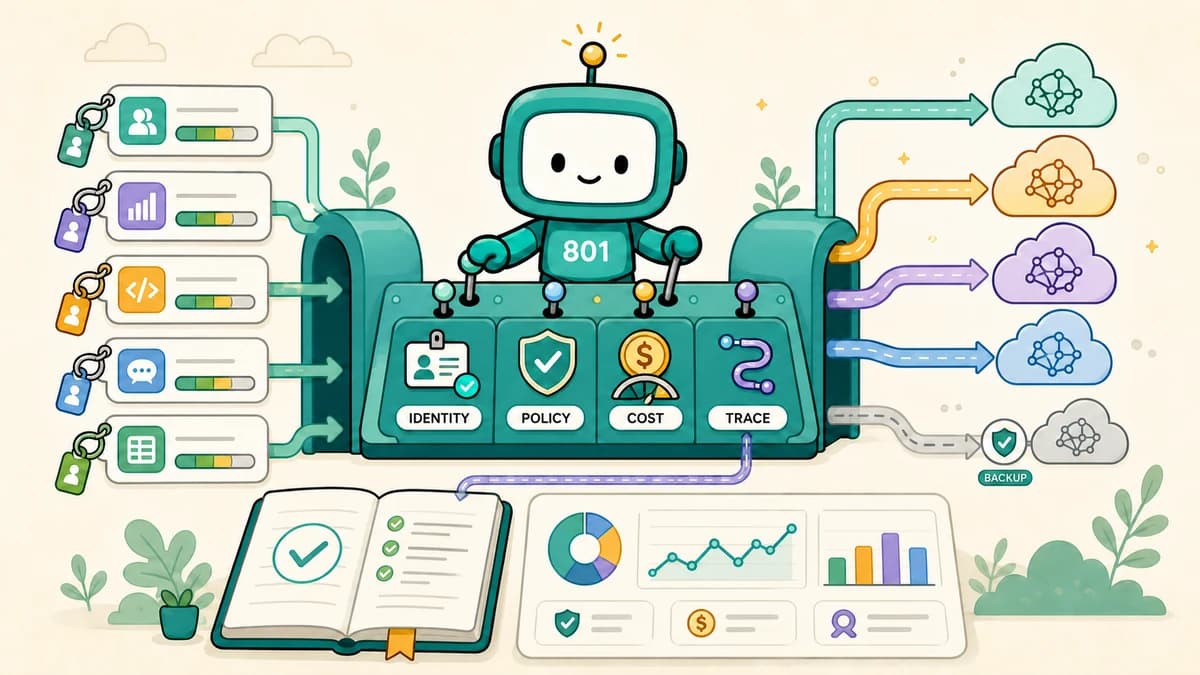
If several products have begun implementing keys, cost controls, guardrails, and tracing independently, use the enterprise AI gateway requirements to define the shared control plane and its acceptance tests first.
Google Cloud's MLOps guidance makes the same engineering point: model code is only a small part of a production ML system, which also needs data validation, testing, delivery, resource management, and monitoring.4 Generative AI does not escape those operating principles.
For a real evaluation of quality, cost, and control when choosing between self-managed and managed retrieval, see our pgvector versus managed Knowledge Base comparison.
Gate 6. Prepare rollback before release
The final gate does not ask whether the team "feels ready." Turn release criteria into statements with a binary result. The AWS Responsible AI Lens recommends quantitative assessments and thresholds across usability, latency, uptime, safety, controllability, security, privacy, robustness, fairness, veracity, explainability, and transparency.5
Do not open the feature to everyone first. Expand the blast radius in stages, such as internal users, a limited customer cohort, or read-only functionality. Attach these controls to every stage.
- A metric that stops the release immediately and the person authorized to act.
- A tested route back to the previous model, prompt, or product path.
- Channels for incidents, wrong answers, and user appeals.
- An operating dashboard and on-call escalation runbook.
- Scheduled evaluation and conditions that force review after data or model changes.
The release is not ready when rollback has never run in the real environment or nobody receives the alert. AWS Well-Architected guidance reaches the same conclusion by applying security, responsible AI, load validation, and operations throughout the generative AI lifecycle.6
End every gate review with one of three decisions
The most useful output is a decision, not a long meeting record.
- Go: all required criteria pass, and the next gate has an owner and date.
- Conditional go: work proceeds inside a constrained blast radius, with an expiry date and exit condition.
- Stop: current evidence does not justify the value or risk. The record states what new information could reopen the decision.
A permanent conditional go destroys the gate. If a condition has no owner or expiry, treat it as a stop. Link every decision to the model, data, and evaluation versions used, plus the approver. An incident review should never have to guess why the release happened.
What production transition really means
Moving an AI PoC into production is not a model-selection exercise. It is product and operating design that turns uncertainty into evidence, limits the blast radius of failure, and preserves reversibility. A PoC that stops at a gate did not necessarily fail. It may have produced the evidence that prevents a much more expensive production failure.
If you need to frame an AI PoC and design its evaluation, security, and operating model together, start with AX Consulting. Implementation of retrieval, evaluation pipelines, and production architecture continues through Data & ML Engineering.
References
Sources & notes6ExpandCollapse
Footnotes
-
NIST, AI Risk Management Framework 1.0 Core. Defines Govern, Map, Measure, Manage, and continuous lifecycle risk management. ↩ ↩2
-
AWS Well-Architected, Responsible AI Lens: Design principles. The principle of starting with a narrow, explicit use case. ↩
-
NIST, Artificial Intelligence Risk Management Framework: Generative Artificial Intelligence Profile, NIST AI 600-1. Generative-AI-specific and amplified risks with suggested actions. ↩
-
Google Cloud Architecture Center, MLOps: Continuous delivery and automation pipelines in machine learning. ML as an integrated system with automated testing, delivery, and monitoring. ↩
-
AWS Well-Architected, Responsible AI Lens: Release criteria. Binary release criteria based on quantitative assessments and thresholds. ↩
-
AWS Well-Architected, Generative AI lifecycle. Security, evaluation, scaling, and operating concerns across the generative AI lifecycle. ↩