A $455K AWS Cost Alert Arrived — The Response Made It Worse

It started with one email. AWS Cost Management had detected unusually high spending in a client's account. The candidate cause was Amazon S3 in Seoul, with usage type APN2-DataTransfer-Out-Bytes. The maximum daily cost impact read $455,441.87.
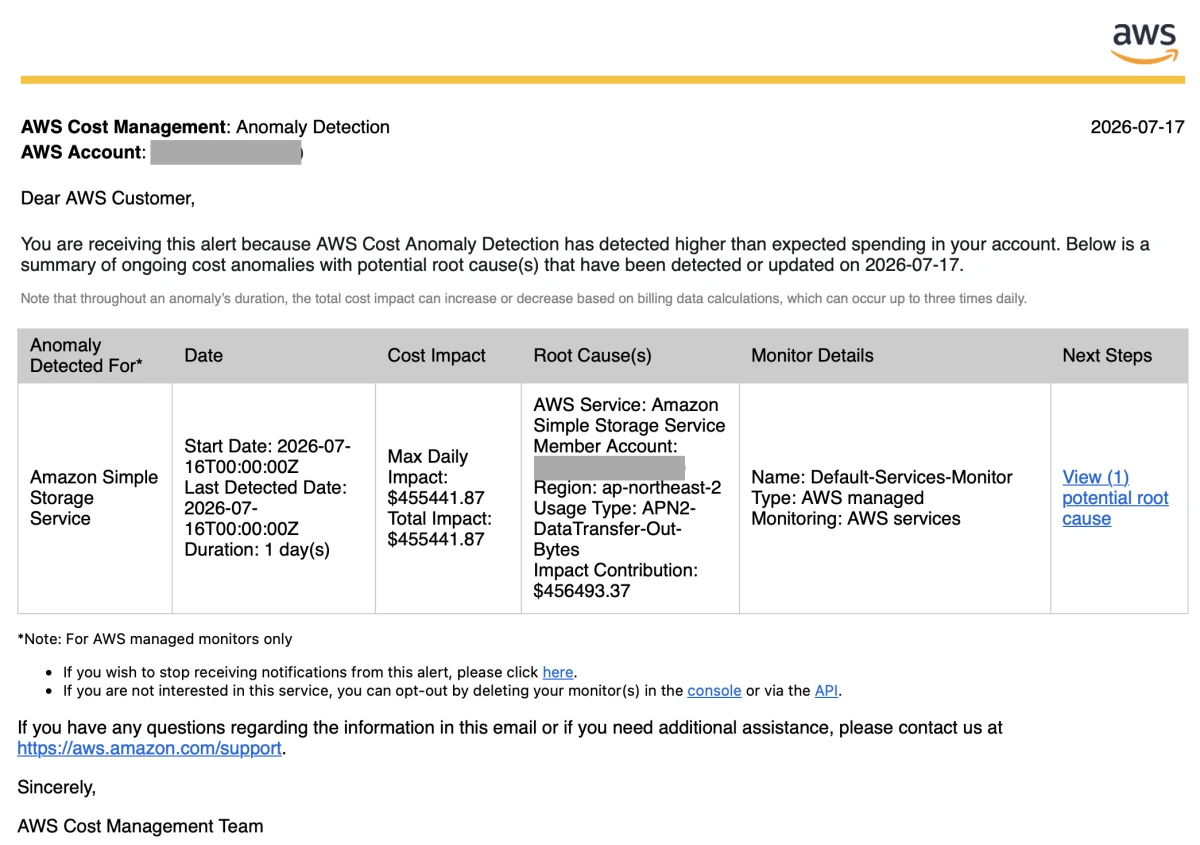
Several thoughts arrived at once. The first decision was still simple: treat it as an incident until someone proves it is an error.
Our first suspicion was account compromise
Nothing in that account should have produced S3 egress at this scale. There was no service change or large data migration. When an unfamiliar charge has no operational explanation, stolen credentials, a changed bucket policy, and abnormal object requests belong at the top of the list.
The account belonged to a client, which raised the stakes. It was a holiday, but both sides opened a communication channel and split the checks. We reviewed cost dimensions and operational evidence; the client reviewed account access and recent changes. An absurd-looking number is not evidence of a false positive.
Refreshing the billing page is not enough in this situation.
- Check AWS Health and Support notices. Separate a shared service event from an account-specific incident.
- Compare the cost dimension with usage evidence. Narrow the service, Region, and usage type, then ask whether S3 request logs, CloudTrail data events, and network-transfer metrics show the same increase.1
- Inspect credentials and policy changes. Look for new IAM users, roles, and access keys; bucket-policy or public-access changes; and unfamiliar source IPs. If compromise is plausible, contain credentials before completing analysis.2
- Share decisions with the account owner. In a client-owned account, communication paths and decision authority matter as much as the technical checks.
We found neither S3 transfer matching $455,000 nor evidence of compromise. The missing piece appeared only when we opened AWS Support.
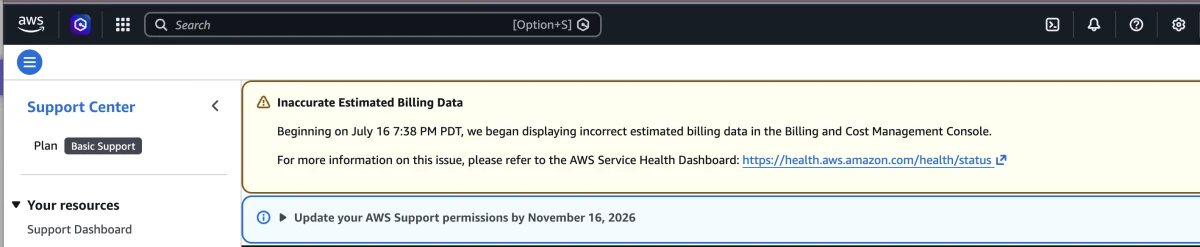
This was not an account incident. It was an AWS estimated-billing error.
We saw $455K; another account saw more than $400B
The error was not confined to one account. Social media filled with consoles showing billions or hundreds of billions of dollars for accounts that normally spent cents or a few dollars. A Japanese console screenshot shared with us showed about $419.1 billion month to date and a $465.5 billion month-end forecast.
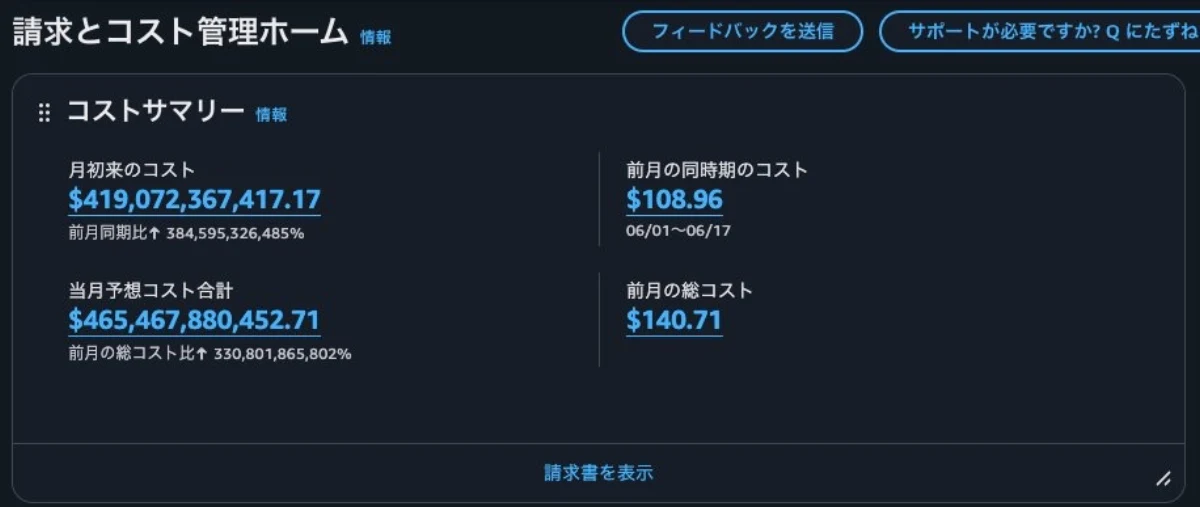
Reported examples went higher. A UK charity whose app normally cost less than £1 per month saw £5.8 billion, and public screenshots reached $1.5 trillion.3 An obviously impossible figure makes a provider-side bug easier to suspect. A few hundred thousand dollars, however, remains plausible for stolen credentials or a runaway configuration. Operators must spend longer proving which one they face.
AWS said inaccurate estimated cost data had appeared from 7:38 PM PDT on July 16. It later identified the direct cause as a unit-pricing issue in the estimated-billing computation subsystem and began backfilling corrected data.4 The displayed amounts did not reflect real usage or finalized charges, and AWS said customers needed to take no action.
That sequence describes a severe bug under repair. The more disappointing part came from the official social channel.
Customers checked for a breach; AWS asked what they would do with the money
The first post from the official AWS X account leaned into a joke. It called quadrillion-dollar estimates a “very slight” miscalculation, then asked customers what they would do with those trillions instead.
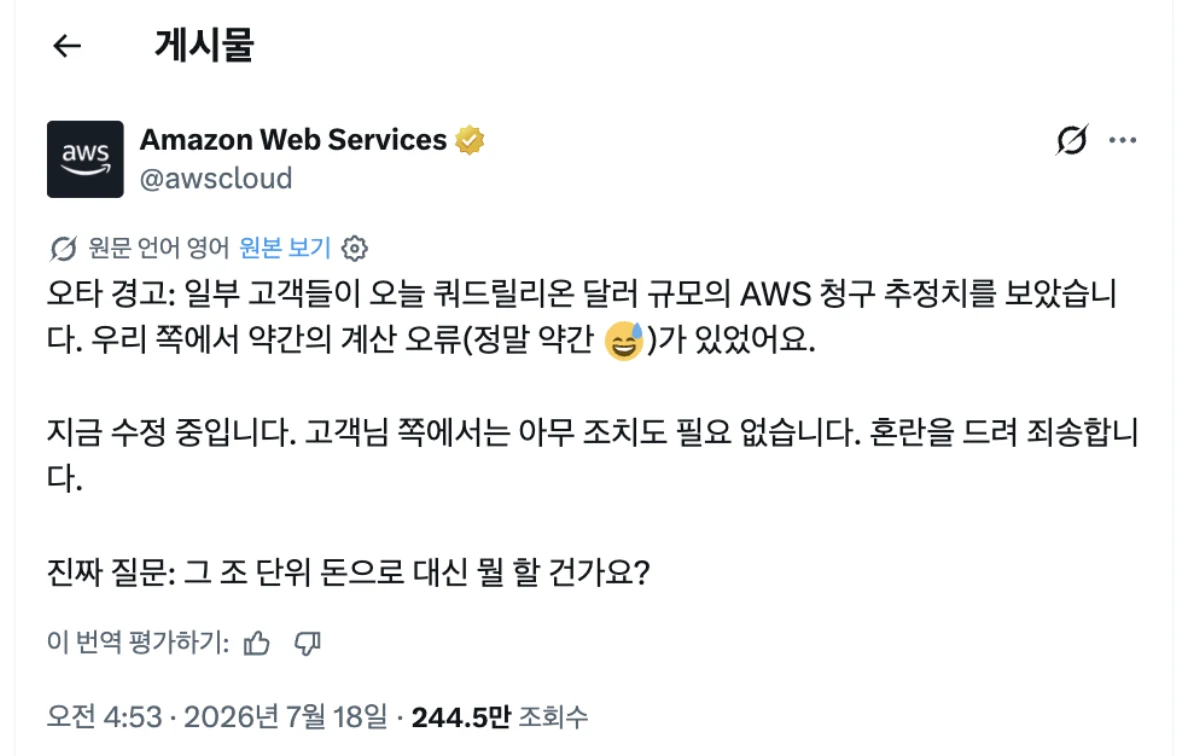
Our lost hours explain why the tone failed. A recipient of a cost alert first checks whether someone has breached the account. For a client account, people open a holiday escalation path, reconstruct changes, and verify service and data safety. Whether anyone could literally pay a trillion dollars misses the point. Customer organizations had already paid for the incident in response time.
An account identifying its owner as an AWS Japan employee also criticized the message and said it would escalate the issue internally. Other AWS users focused on the same gap. Humor from an official account works only when the company and its customers share the same context. AWS already knew it had a billing error; many recipients still did not know whether their own accounts were safe.
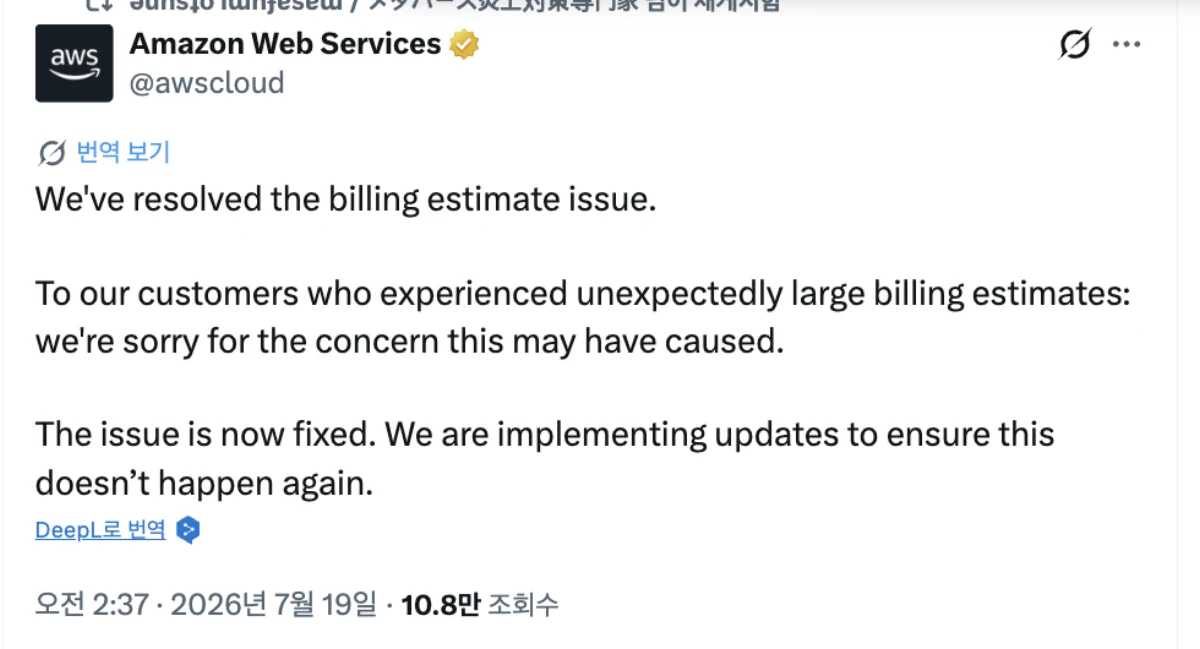
AWS later posted a restrained resolution notice. It apologized to customers who saw unexpectedly large estimates, said the issue was fixed, and promised updates intended to prevent a recurrence.
Separate the disclosed cause from the speculation
AWS has disclosed the immediate cause: incorrect unit pricing entered the estimated-billing computation. It has not published which change introduced that price, why validation and deployment controls missed it, or how the faulty estimate propagated through Cost Anomaly Detection.
Some community posts blamed uncontrolled use of AI coding assistants. No AWS statement or verifiable evidence supports that theory. Calling AI the cause would replace a concrete discussion of validation, isolation, and communication controls with an unsupported tool narrative. Until AWS publishes a postmortem, it remains speculation.
The confirmed questions are more useful:
- What range and invariant checks protected unit-pricing changes?
- If billing estimates and Cost Anomaly Detection share a failure domain, what independent signal verifies either one?
- When a cost-anomaly email precedes a service-status notice, where should customers check for a common incident?
- How quickly did the most important sentence, “not actual usage or charges,” reach every affected channel?
A CloudFront incident the day before turned two bugs into a trust problem
On July 16, one day before the billing reports, CloudFront customers using VPC Origins experienced elevated 5xx errors. The published incident summary says the system distributing routing configuration to network processors failed to load updated data correctly, affecting VPC Origin connections.5
There is no evidence that the CloudFront outage and billing error shared a technical cause. Nor should two incidents define an entire platform. Customers still experience them as a sequence: a network feature disrupted production one day, and an impossible charge triggered a breach investigation the next. A flippant first response turns isolated defects into a trust problem.
Normal incident response from a global cloud provider does not end when the service recovers. It must also explain how long customers carried uncertainty, which unnecessary actions they had to take, and what signal they should trust the next time.
The next cost anomaly needs three independent signals
Our operating rule after this incident is straightforward.
| Signal | What to inspect | Limitation |
|---|---|---|
| Cost | Cost Anomaly Detection, Cost Explorer, Budgets | They can share the same faulty estimated-billing data |
| Usage | Service request logs, transfer volume, CloudWatch metrics | S3 data events and access logs cannot reconstruct the past if they were never enabled |
| Account | CloudTrail, IAM and bucket-policy changes, GuardDuty | They cannot explain a pure billing-computation error with no real usage |
Route AWS Health events to email, chat, or mobile push, and aggregate events across the organization.6 Public service events are not available through managed notifications, so the runbook must still include the public Health Dashboard. It should also name client contacts and decision owners for the hours when provider communication lags.
A cost alert is not merely a finance notification. It may indicate a stolen account, runaway automation, or a provider-side computation failure. Customers must act in every case. The accuracy and tone of this channel therefore belong to cloud security and operational trust, not billing alone.
We design account-compromise response, cost-anomaly detection, and AWS Health routing as one runbook through Cloud & Infrastructure.
References
Incident times and the cause reflect public AWS Health updates and reporting available on July 19, 2026. The technical scope may change if AWS publishes a detailed postmortem.
Sources & notes6ExpandCollapse
Footnotes
-
AWS Docs, Logging Amazon S3 API calls using AWS CloudTrail. Explains how CloudTrail and server access logs identify S3 request principals, source IPs, and object-level operations. ↩
-
AWS re:Post, What do I do if I notice unauthorized activity in my AWS account?. Covers credential containment, CloudTrail investigation, and AWS Support escalation. ↩
-
The Guardian, Amazon Web Services customers receive bills for up to $1.5tn after global glitch (Jul 17, 2026). Reports customer examples and AWS's initial apology. ↩
-
TechRadar, Customers see bills in the billions after AWS billing system goes haywire (Jul 17, 2026). Quotes the AWS Health timeline and unit-pricing explanation. ↩
-
IncidentHub, The July 2026 AWS CloudFront Outage: VPC Origins, Cascade Impact, and What Broke (Jul 17, 2026). Summarizes the event window and VPC Origins impact from AWS Health updates. ↩
-
AWS Docs, Manage AWS Health notifications in AWS User Notifications. Documents email, chat, mobile push, organization aggregation, and the exclusion of public service events. ↩